
Since the advent of commercially available generative AI, the role digital learning plays in organisations has been evolving faster than we’ve seen in decades.
In terms of its application – we’re seeing an increasing gulf between digital learning’s role in knowledge delivery solutions, and skills practice opportunities.
Here’s a lateral example that nicely highlights the difference…
In 2009 Captain Chesley Sullenberger (Sully) and his crew were faced with the unenviable task of having just under four minutes to land Flight 1549 following a catastrophic bird strike.

Their ability to land on the Hudson saving the lives of all on board was driven not by just knowing how but having practised the skills in simulations. And we’re not just talking about the flight simulators, but also Crew Resource Management training – simulating the communication and decision-making skills the whole crew required to perform under pressure.
In Sully’s own words:
“Pilots must develop the muscle memory to be able to quickly and effectively respond to a sudden emergency. Reading about it on an iPad is not even close to sufficient; pilots must experience it physically, firsthand.”
At Make Real, we’ve worked in both knowledge delivery and skills practice, specialising in the latter. We create learning experiences that mimic the real-world situations learners come across in their working lives. So, when they’re practising, they’re developing critical muscle memory for both technical and interpersonal skills. This is what we mean by immersive learning.
We see the value of skills practice via simulation is borne out by our work with customers including NHS Blood and Transplant and London Business School…
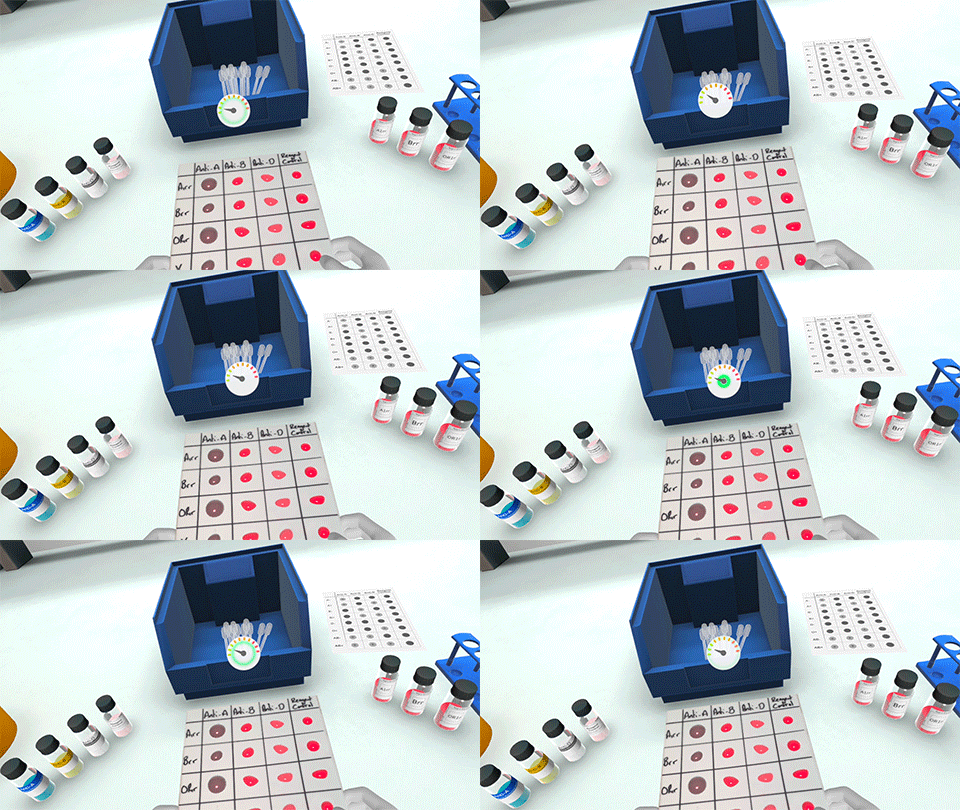
And studies show that game-based simulations lead to…
So the case for immersive learning is a compelling one – especially in high-stakes environments where there are few opportunities for real-world practice.
Now, as you might be aware, we don’t just work in learning. We create experiences for entertainment, including arena-based immersive attractions, VR games and interactive visitor centres and exhibits.
We often find that the design approaches we use in our entertainment work provide inspiration and new approaches for captivating learning simulations. And that’s true for in-person learning, on a laptop or phone, or in fully-immersive VR environments.
In this short series of blog posts, we’ll be covering three of these design approaches in turn.
Acquiring knowledge and practising skills are different ways of learning.
For knowledge-based learning: you don’t really need to change your mindset very much to learn. You need to know a fact, for example a process or set of instructions. You learn the fact. And you use it.
But for skills practice to feel as realistic as possible we need to transport the learner from where they are to the simulated experience, to help them move from a passive mindset to the active mindset needed to practice those skills effectively.
As anyone who’s ever participated in a very awkward face to face role play knows… context matters. And setting that context up correctly, in a way that immerses the learner, vastly improves the effectiveness of the experience.
Embodiment is something the immersive entertainment world often does brilliantly. Often the process of immersion begins well before people start consuming the ‘content’ – whether that’s a game or an exhibit.
Our good friends at Little Lion Entertainment execute this brilliantly in the PAC-MAN LIVE experience.
From the moment players step inside the venue, everything is set up to get the players ready to become PAC-MAN. They aren’t simply thrown into a maze to start running around.
Getting the players to take actions – like speaking a ‘magical’ incantation, inserting a giant coin into an arcade machine, putting on their PAC-MAN tracker – everything gets them set for a frantic cardio-driven game.
In immersive learning it’s equally important to do the same context-setting to transport learners to a realistic scenario.
With Master Builders Victoria down under in Australia, we developed an immersive construction simulator, which uses projection-mapping and tracking to allow trainees to explore a construction site without real-life risk. But the setup begins much earlier.
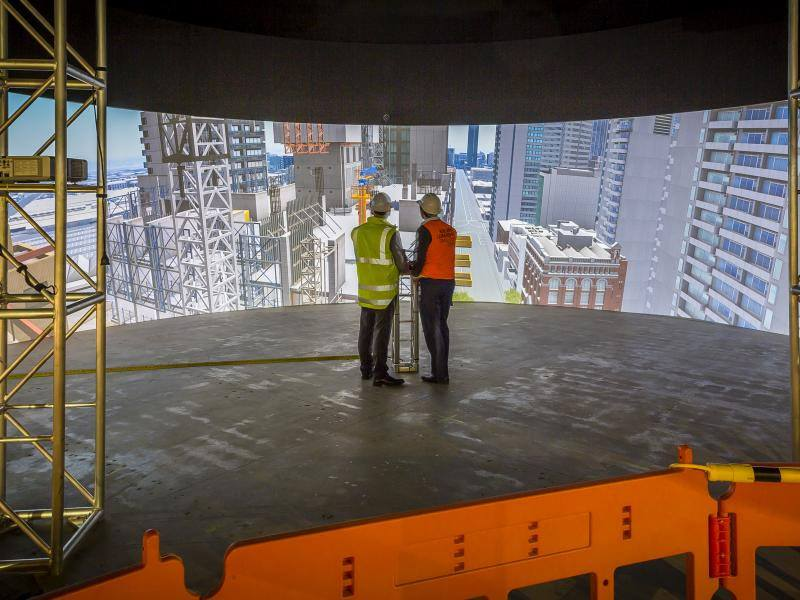
Before trainees step inside the simulator, they get ready for a ‘day’ on site, complete with donning PPE and participating in briefing meetings. They face challenges that occur on a real construction site, handling miscommunications, disagreements, potential hazards – but all in a space that allows them to safely fail.
It’s far more effective than having a trainer stand at the front of a classroom clicking through PowerPoint slides to explore the scenarios.
Now you may be thinking ‘large scale projection mapped learning environments aren’t needed in my organisation’.
However, the same design principles apply to more commonplace single-user digital experiences. In fact, the scene-setting becomes even more important when you have only a laptop to do it with.
We worked with London Business School on a tool that allows learners to practise their business storytelling skills, with feedback on their story and delivery provided by generative and emotional recognition AI.
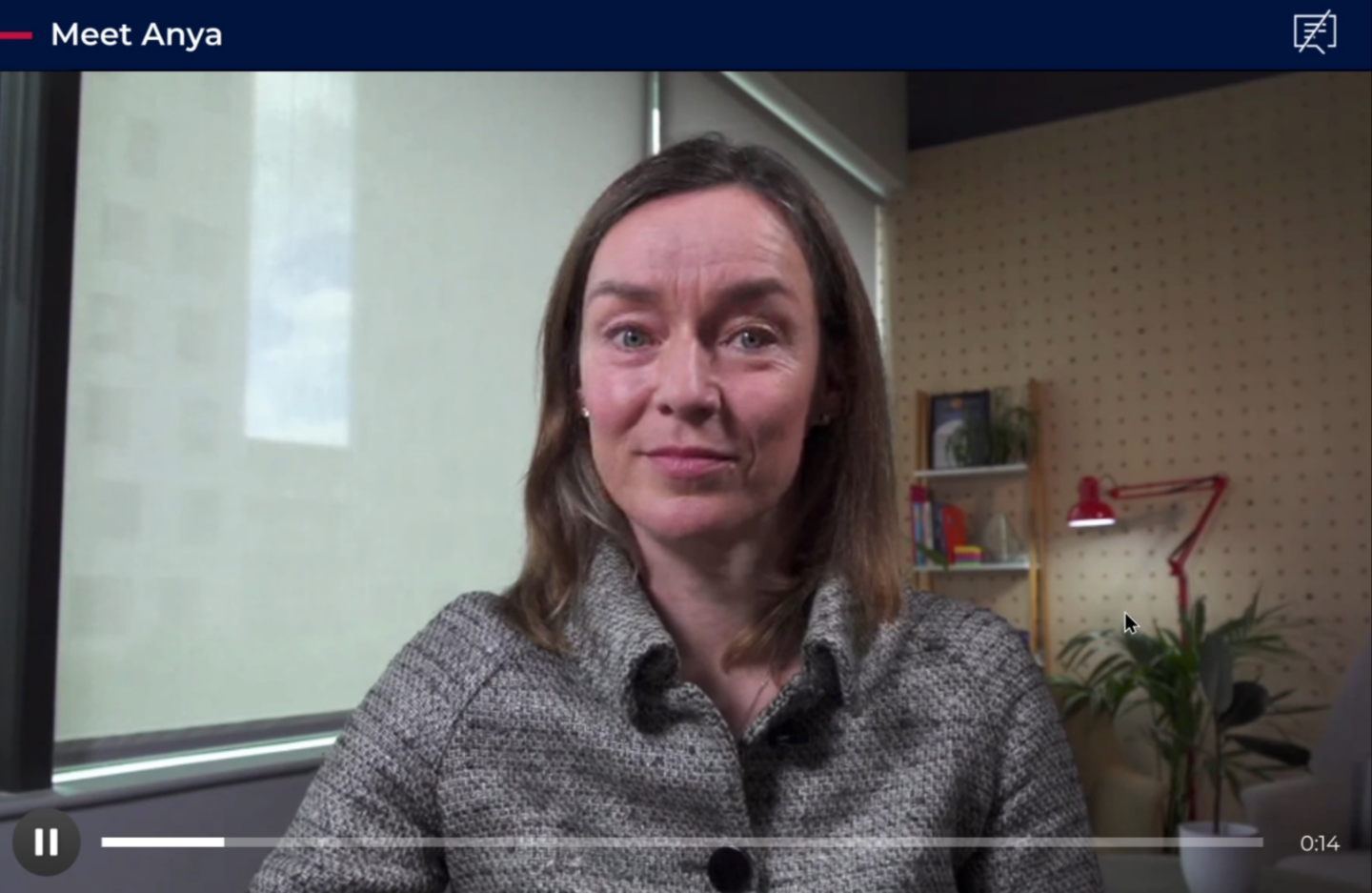
But we don’t just throw learners into telling their story and providing feedback on their performance right away. Instead, we structure the experience…
And all of this gets learners ready to tell their story without being thrown into the deep end of talking out loud to their computer all alone.
Whatever way your learners are accessing their training, getting them in the right frame of mind is key to unlocking their learning potential. If they can practise their skills in a simulated environment, that closely mimics the situations they’ll really need those skills, they’re much more likely to put the skills to use.
—
So, we’ve covered the staging and framing of an experience. In our next post we’ll explore cognitive flow and load – that is, getting the balance of challenge and engagement just right for your learners to help them to develop mastery via repeat practice.
We’re always happy to talk to you about how immersive technologies can engage your employees and customers. If you have a learning objective in mind, or simply want to know more about emerging technologies like VR, AR, or AI, send us a message and we’ll get back to you as soon as we can.