
Storytelling is a vital leadership skill, but traditional coaching and actor-led sessions were costly, inconsistent, and hard to scale. LBS needed a solution that delivered personalised, impactful development while remaining accessible to all learners.
They’ve worked with us to create an AI practice app that helps current and future leaders tell stories that persuade and inspire, by taking the listener on a journey.
The tool combines emotional recognition AI and generative AI coaching, simulating a conversation with a fictional senior stakeholder. Learners practise their personal brand story, receive immediate feedback on their delivery and emotional presence, and benefit from expert-aligned coaching tips based on LBS faculty guidance.
We carried out a study comparing AI users to a control group using traditional materials which found that the AI group reported:
At London Business School (LBS), storytelling plays a critical role in shaping how future leaders communicate their experiences, influence stakeholders, and inspire teams. However, although LBS offered opportunities to learn the theory of storytelling, there was no scalable way for learners to practise.
Learning was primarily done through lectures, reading articles, watching videos, and carrying out reflection activities. Coaching and actor-led simulations were used on some courses but were:
LBS needed a scalable, interactive learning tool that offered high-quality feedback, allowed for repetition, and could support personalised development – meeting individual needs and strategic learning goals. LBS set out to create a practice-based learning experience that rivalled live coaching in quality, but with the scale and consistency of a digital tool.
Make Real partnered with LBS to design and build the AI Storytelling Practice Tool – a simulation-based experience that integrates emotional recognition and generative AI feedback. We worked closely with LBS faculty to embed their expert guidance on what constitutes strong storytelling and trained the generative AI to give feedback based on this.
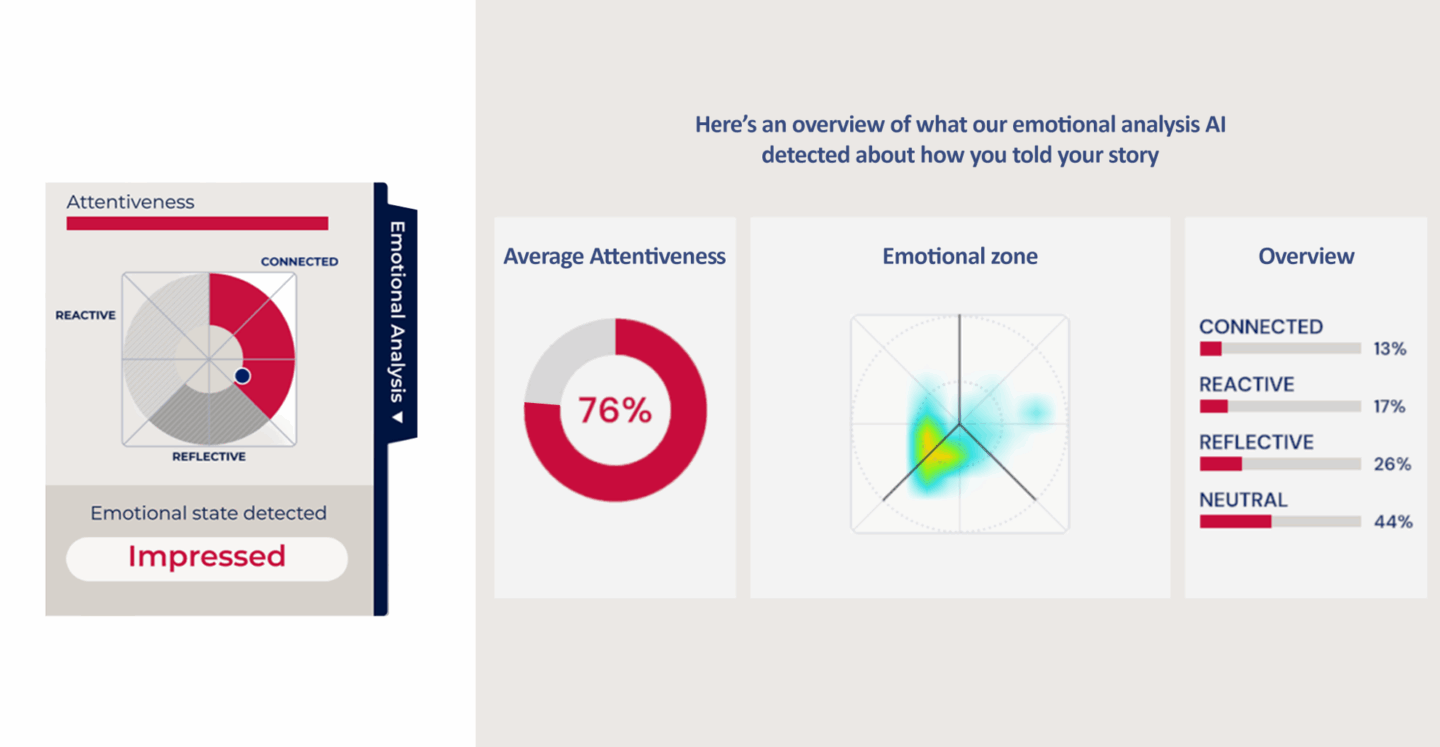
As well as generative AI, the tool uses diagnostic AI to give learners an idea of how they’re coming across in the delivery of their story.

The AI model has been trained with the view to remove bias and give consistent results, whether you wear glasses, have facial hair or have other distinctive facial features or coverings. But the feedback it offers isn’t about detecting your intended emotions with 100% accuracy.
Instead, it’s about giving you a glimpse of how you might appear through someone else’s eyes and holding a safe space for you to improve under your own direction – just like a human coach would. We like to say it’s a mirror not a judge.
The tool is available for learners to use whenever they need it, an intervention that they can call on any time of day or night (when a coach or mentor might be tucked up in bed!).
To evaluate the impact, we ran a comparative study with a control group using traditional materials.
Learners using the AI tool showed:
Qualitative feedback reinforced these findings:
The study also revealed improvements that we could make. We found the participants who weren’t telling their story in the most compelling way – who the app could help the most – were receiving emotions like ‘worried’ or ‘concerned’. And they were finding those words critical and hard to hear, which was interrupting their ability to benefit from the tool.
So, we made some adjustments based on what we learned. In the latest iteration, we’ve grouped the emotions together into four categories: connected, reflective, reactive and neutral. We coach learners that they might want to spend much of their story in a connected state, but there’s room for all of them in a dynamic delivery.
Initial user testing was positive, but we wanted to understand the real difference it made, so we commissioned another round of research. In the first study, 12.9% of the group had spontaneously reported feeling unfairly judged or miscategorised by the tool. In the latest round of research, none of the participants reported feeling this way.
But we still needed objective analysis. So, we created a panel of storytelling experts to provide feedback on learners’ storytelling skills.
Based on the judge’s grading, the app group saw a higher overall performance score, compared to the control group. The app group also saw a higher uplift in authentic delivery and a desire to network with the participants in the future. It’s important to acknowledge that there were areas where the control group outperformed the app group, but these were all around the content of the story they told – as opposed to the delivery.
But what emerged was a more nuanced picture than the app was ‘better’.
It helped people improve overall but traditional methods were better at teaching the theory, though not as good at the execution. So this points towards the fact no one method in isolation is going to be a panacea when practising a new skill. These measurements tell us where each intervention adds the most value so we can deploy them to the best effect.
And in 2025, the tool won a Silver Learning Technologies Award in the ‘Best use of AI (UK)’ category, with the judges commenting…
“This entry shows an innovative and impactful use of AI to help leaders master one of the most important capabilities that’s difficult to personalise at scale: telling their story authentically and effectively. The judges were impressed by how the team overcame complex hurdles to bring this to life, creating a powerful and scalable model for developing this critical leadership skill. An outstanding Silver winner.”
We’re always happy to talk to you about how immersive technologies can engage your employees and customers. If you have a learning objective in mind, or simply want to know more about emerging technologies like VR, AR, or AI, send us a message and we’ll get back to you as soon as we can.