Challenge
Inducting workers onto tunnelling sites is time consuming and potentially dangerous with tight, cramped working conditions.
Onboarding new employees needs to be safe but able to convey the numerous dangers and procedures required to operate within guidelines underground.
Our challenge was to create induction content by incorporating immersive technologies and finding an engaging way to encourage people into the industry.
The immersive learning materials results included:
- 92% of learners rated the VR elements as stimulating and engaging with scores of 4 or 5 out of 5.
- 63% of learners were very satisfied with the experience, and a further 35% were satisfied.
- 94% responded that their learning objectives were achieved.
- 74% of learners said they had developed other skills or knowledge as a result of the immersive learning resources.
- 91% were very satisfied or satisfied with how easy the apps were to use.
Use Case
Finding ways to engage and encourage people into the construction industry is an ongoing challenge.
In September 2017 the Construction Industry Training Board (CITB) published research on the value, opportunities and barriers of immersive learning adoption in construction training. Their research found that immersive learning can help address a range of challenges in the following ways:
- Enhance the industry’s appeal to ‘digitally-native’ audiences through future-focused technology
- Increase the quality and coverage of training by providing experiences and environments that may not be possible via traditional methods, making students more ‘work-ready’
- Improve levels of collaboration and problem-solving tasks that stimulate more interrogation and knowledge retention
- Reduce cost of delivery and optimise trainers’ time by improving tutor / student ratios and freeing up time for more technical aspects
In early 2019, following the research, the CITB approved funding for a number of benchmark projects that use immersive technologies with the intention of piloting and measuring their effectiveness. Inducting people into tunnelling skills projects was one of those funded by the CITB and delivered using match funding in partnership with TunnelSkills, Morgan Sindall and BAM Nuttall, utilising partnerships and engagement with existing large-scale real-world development sites, including Thames Tideway, HS2 and HPC.
The objective was to blend existing behavioural induction training for a wide range of learners across sectors, with new immersive learning content. We were aiming to enthuse industry through engagement of workers and potential employees, whilst helping reduce induction time, improve memory retention and behaviour, ensuring inductee safety.
These included:
- Tunnelling Operative apprentices
- Existing tunnel construction employees
- Other project employees (including non-construction employees e.g. back-office staff, managers, supervisors, designers)
- Those undertaking cross-industry courses, such as Tunnelling Safety Training Scheme, City & Guilds Tunnel Entry (6151), Site Supervisor Safety Training Scheme and Site Management Safety Training Scheme
- College and school students
Hardware
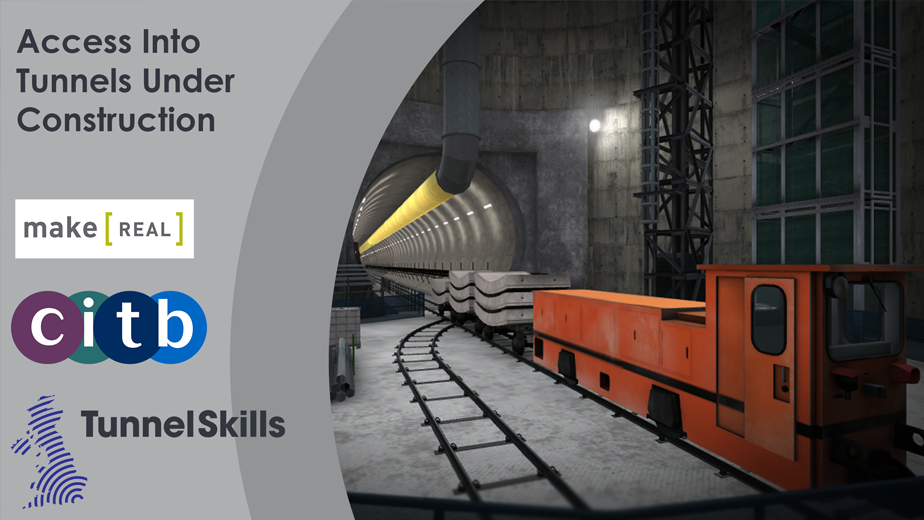
Due to the mix of content utilising 360º video and 3D CGI interactive scenes, Meta Quest standalone VR devices were the chosen final deployment hardware.
Build
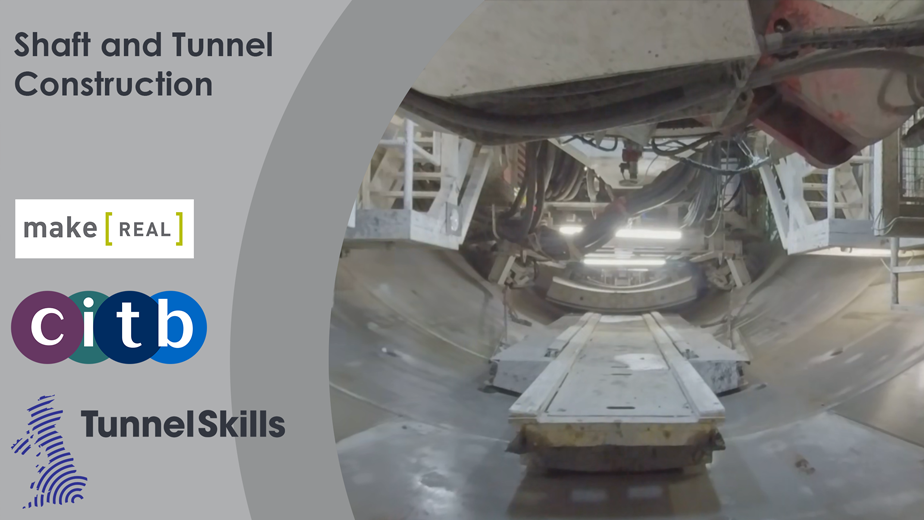
The content was created using Unity 3D engine for VR support. 360º filming took place underground by our resident freelance filmographer Michael Danks, accompanied by trained tunnel skills and organisational representatives.
Impact
In 2023, TunnelSkills submitted its project report showcasing the results…
- 92% of learners rated the VR elements as stimulating and engaging with scores of 4 or 5 out of 5.
- 63% of learners were very satisfied with the experience, and a further 35% were satisfied.
The project asked learners whether they felt learning objectives (such as choosing appropriate PPE, spotting hazards, emergency response in a tunnel) had been met.
- 94% responded that their learning objectives were achieved.
- 74% of learners said they had developed other skills or knowledge as a result of the immersive learning resources.
- 91% were very satisfied or satisfied with how easy the apps were to use.
And feedback included comments such as:
- “Far more memorable than a PowerPoint session.”
- “I am able to retain more information by participation.”
- “[I have] an understanding of the size and scale of different tunnelling environments.”
Trainers commented that the immersive learning achieved:
- “Better candidate engagement.”
- “Better situational awareness which cannot be achieved through traditional methods.”
- “Better awareness of specific hazards of tunnelling through 360° videos.”
The project also carried out targeted activity to reach young female students, especially those who may have been making decisions about future careers.
- 23% of those who completed the forms were female, significantly higher than the 13% female population within the construction sector as a whole in 2023.
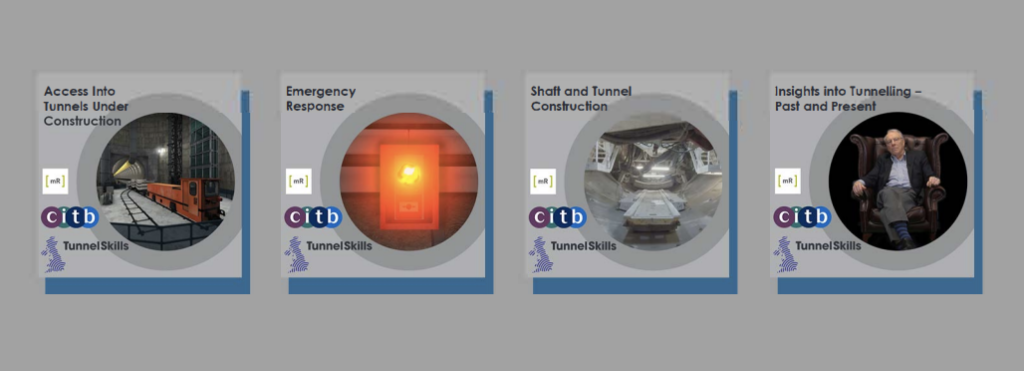
These VR apps are available to download for free through the Meta Quest App Store, check the links on the right hand side for details >>>